

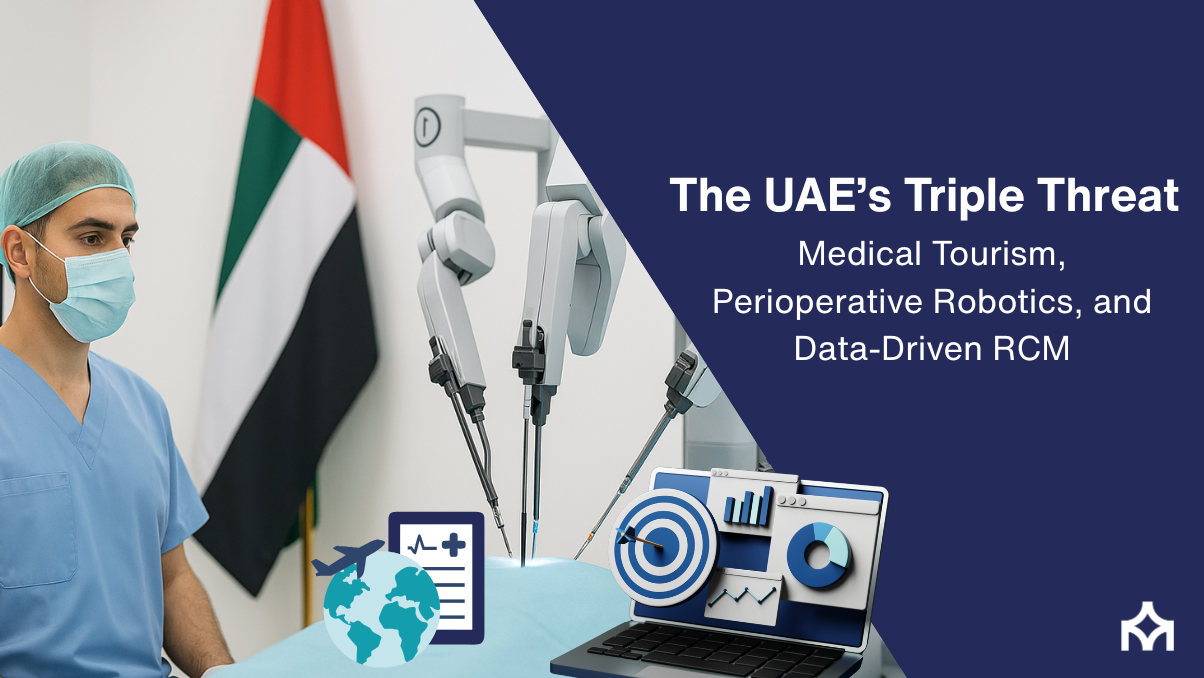
The UAE’s Triple Threat: Medical Tourism, Perioperative Robotics, and Data-Driven RCM
The UAE’s Triple Threat: Medical Tourism, Perioperative Robotics, and Data-Driven RCM
The United Arab Emirates is rapidly redefining what modern healthcare looks like. With the sector projected to exceed $50 billion by 2029 (Mordor Intelligence, 2024), the UAE is rising as a global healthcare powerhouse, not because of infrastructure alone, but because of a deliberate, strategic integration of clinical technology, operational analytics, and financial intelligence.
This alignment forms the UAE’s “Triple Threat”: medical tourism, perioperative robotics, and data-driven RCM, a blueprint that many international health systems are beginning to emulate.
1. Perioperative Robotics: The Clinical Magnet for Global Patients
For medical tourists, the UAE competes on a simple value proposition: better outcomes, shorter recovery, and higher safety. Dubai welcomed more than 674,000 medical tourists in 2022 (Dubai Health Authority, 2023), and much of this demand is fueled by the country’s leadership in robotic-assisted surgery.
Robotic platforms such as the da Vinci system offer unmatched surgical precision, enabling minimally invasive procedures with:
- Less pain and reduced trauma
- Fewer complications
- Shorter hospital stays
- Faster return to normal life
Regional data shows robotic-assisted procedures can reduce complication rates by up to 30% (Middle East Robotics Surgery Review, 2023).
Patients interpret this investment as trust and quality. The UAE is engineering an optimized perioperative journey through standardized workflows, advanced imaging, OR readiness protocols, and surgeon training that accelerate safe discharge.
2. Healthcare Analytics: The Operational Engine Behind Precision Care
As robotic procedures increase, the need for flawless operational execution becomes even more critical. This is where the UAE’s growing analytics leadership stands out. The healthcare analytics market is projected to reach $909 million by 2030 in the region (Business Market Insights, 2023).
With platforms such as DHA’s Health Data Platform integrating data from 1,500+ facilities, providers can leverage analytics for:
- Risk identification: Predictive models flag post-op risks earlier.
- Enhanced Recovery After Surgery (ERAS): Data ensures strict adherence to ERAS pathways, accelerating discharge and improving outcomes.
- Capacity optimization: Real-time OR utilization data improves scheduling and reduces delays.
Analytics turns robotic surgery from a clinical capability into a scalable, reliable service line.
3. Data-Driven RCM: The Financial Anchor That Makes Innovation Sustainable
Robotic programs and global patient volumes only thrive when the financial backbone is strong. High-acuity robotic cases require specialized RCM to capture accurate reimbursement.
Data-driven RCM improves financial performance through:
- Precision coding: Ensures robotic assistance and complex care pathways are documented correctly to avoid underpayment.
- Denial prevention: Analytics-driven checks reduce denials by 20–40% (HFMA, 2024).
- High clean claim rates: AI-enabled workflows can push clean claim accuracy above 98%.
The Power of Integration: Why the Triple Threat Matters
The UAE’s competitive edge lies not in adopting technologies in isolation but in connecting them:
- Robotics elevates clinical outcomes.
- Analytics strengthens operational reliability.
- RCM ensures long-term financial viability.
This “Triple Threat” doesn’t just attract global patients, it sets a new standard for how modern health systems can scale robotics, compete in medical tourism, and maintain profitability in high-cost environments. As global health markets become more competitive, the UAE’s model serves as a powerful example:
When robotics, data, and RCM converge, world-class patient outcomes and sustainable financial performance follow.
Sources
- Mordor Intelligence (2024)
- Dubai Health Authority (2023)
- Middle East Robotics Surgery Review (2023)
- Business Market Insights (2023)
- DHA Health Data Platform (Dubai Health Authority)
- HFMA (2024)