

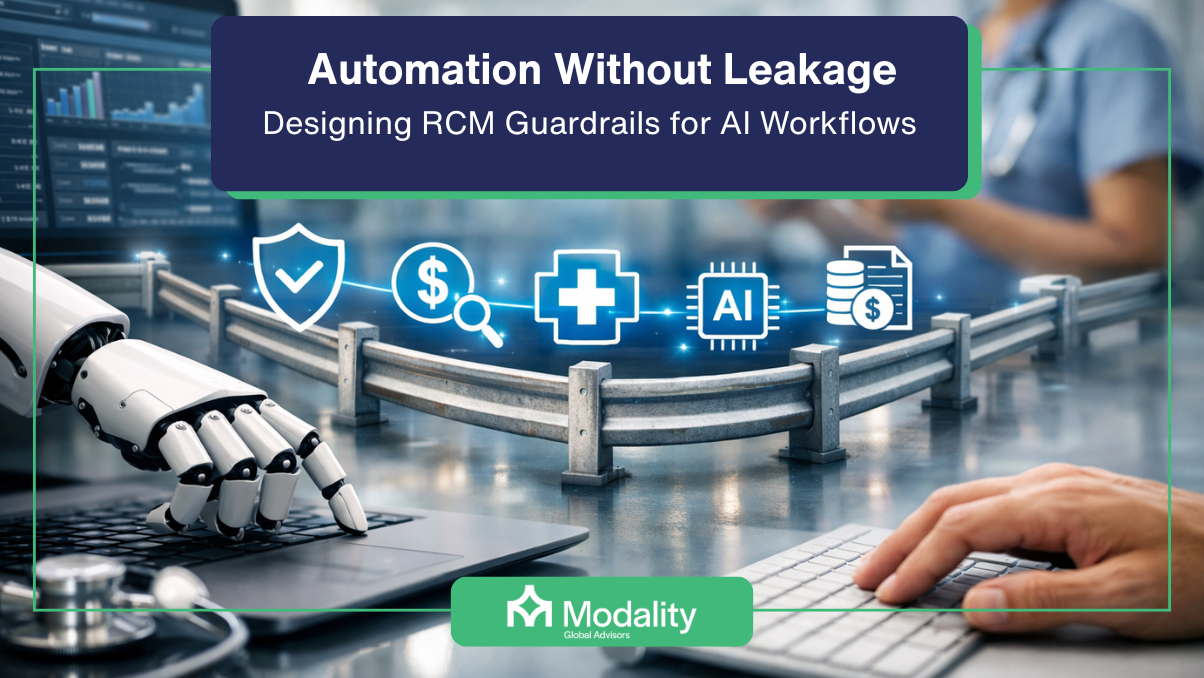
Automation Without Leakage: Designing RCM Guardrails for AI Workflows
Automation Without Leakage: Designing RCM Guardrails for AI Workflows
Healthcare organizations are accelerating automation across the revenue cycle to offset labor shortages and rising costs. But speed without control creates a new risk: AI-driven revenue leakage. When automation scales flawed inputs or outdated payer logic, denials increase, rework grows, and Days in A/R climb. For CFOs, COOs, and Revenue Cycle leaders, the goal is not more automation, it is controlled automation that protects margin. The Problem: Faster Workflows, Faster Mistakes Automation is now embedded in eligibility checks, claim edits, coding assistance, and denial workflows. Yet many systems operate without structured financial safeguards. Common failure points include: Bad data in, fast denials out Up to 70% of denials originate from front-end errors like eligibility, authorization, and demographic mistakes (Change Healthcare Denials Index, 2025). Automation processes these errors at scale.
No real-time correction loop Many systems flag issues only after payer rejection. By then, cash is delayed and staff must rework claims.
Static payer rules Payer policies shift frequently. Outdated automated edits increase rejections, contributing to industry denial rates that still hover around 10–15% (HFMA, 2025).
The Solution: Build RCM Guardrails Into AI Workflows Guardrails are embedded controls that ensure automation aligns with payer rules, documentation standards, and financial performance goals. 1. Front-End Financial Accuracy Prevent denials before claims are created: Real-time eligibility and benefits validation
Automated insurance and demographic verification
Authorization tracking tied to scheduling
These steps directly improve Clean Claim Rate (CCR) and reduce downstream rework. 2. Predictive Denial Prevention AI should flag risk before submission, not after denial. Models trained on historical denial data
Alerts for missing documentation or payer-specific edits
Continuous rule updates aligned with payer changes
Organizations using predictive denial tools report meaningful gains in first-pass acceptance rates and lower administrative rework (Experian Health, 2025). 3. Mid-Cycle Documentation Guardrails Automation must validate clinical and coding integrity: Medical necessity checks
Procedure-to-diagnosis alignment
Documentation completeness prompts for providers
This protects against clinical denials and underpayments, which are costly to overturn. 4. Back-End Feedback Loops Denial trends must inform upstream fixes. Root-cause denial categorization
Automated alerts to registration, coding, or CDI teams
Dashboards tracking payer behavior and recurring errors
The Value: Financial Stability When automation is governed by RCM guardrails, the financial impact is measurable. Higher Clean Claim Rates → Fewer resubmissions and faster payment
Lower Days in A/R → Improved liquidity and working capital
Reduced Cost to Collect → Less labor spent on rework
Stronger Compliance → Lower risk from automated errors
Automation becomes a revenue protection tool, not just a labor reduction strategy. Conclusion AI in RCM is no longer experimental. The differentiator now is control. Health systems that embed guardrails into automation workflows prevent leakage before it starts, stabilize cash flow, and protect contribution margin. The question for leadership is not “How much have we automated?” It is “Where are our financial guardrails?”
Sources: (Change Healthcare Denials Index, 2025) (HFMA Revenue Cycle Trends Report, 2025) (Experian Health State of Claims Report, 2025)