
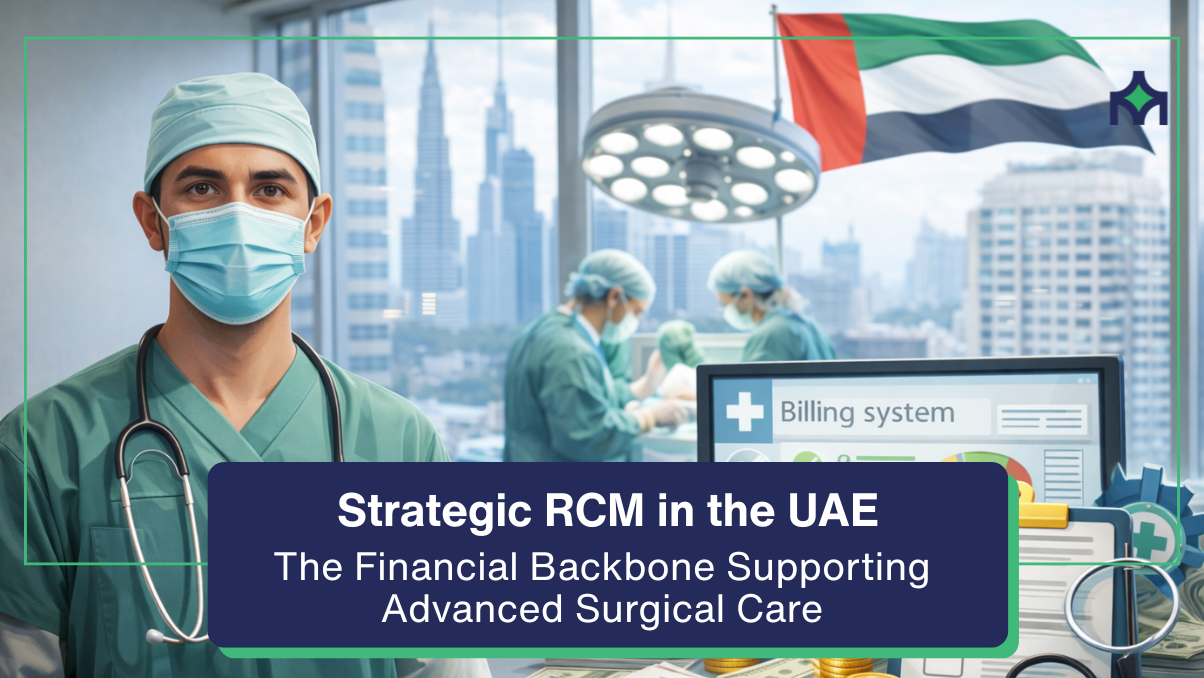
Strategic RCM in the UAE: The Financial Backbone Supporting Advanced Surgical Care
Strategic RCM in the UAE: The Financial Backbone Supporting Advanced Surgical Care
The UAE has established itself as a global hub for advanced surgical care. Hospitals across the UAE continue to invest aggressively in robotic surgery, AI-guided diagnostics, hybrid ORs, and high-cost surgical implants. These investments are transforming clinical outcomes but without equally sophisticated Revenue Cycle Management (RCM) infrastructure, many health systems are struggling to translate clinical innovation into sustainable financial performance. The gap between clinical capability and billing maturity has become one of the most pressing operational risks in the region. The Surgical Boom Is Outpacing Revenue Infrastructure The UAE’s healthcare sector is projected to exceed AED 127 billion in total spending by 2026, driven largely by surgical technology expansion, population growth, and medical tourism (Fitch Solutions, 2024). The surgical robotics market alone is growing at 25.2% CAGR through 2026 (Mordor Intelligence, 2024). Concurrently, Ambulatory Surgery Centers (ASCs) are shifting toward higher-acuity, same-day procedures including robotic-enabled orthopedics, cardiology, and oncology interventions (Colliers, 2023; Alpen Capital, 2024). However, national payer mix complexity remains high: 70%+ of claims in the UAE are processed by government or semi-government payers (Thiqa, Daman, DHA-Enaya, MOHAP, and ADNIC)
The remainder flows through private insurers and TPA networks that enforce strict medical-necessity, authorization, and documentation policies (Alpen Capital, 2024).
Many providers still operate manual coding, fragmented charge capture, and non-predictive denial workflows, resulting in revenue leakage, claim rejections, and inflated Account Where UAE Health Systems Leak Revenue in Surgical Care 1. Authorization-to-Procedure Mismatch UAE payers enforce pre-authorization for 92–96% of inpatient and high-cost surgical procedures. When approvals fail to reflect actual OR-delivered care, hospitals face non-reimbursable charges and denied claims (Daman Claims Report, 2024). 2. High-Cost Consumables and Implants Robotic procedures, hybrid OR cases, orthopedic implants, cardiac stents, and oncology consumables introduce millions in unreconciled charge risk when not captured at the item-level in the chargemaster or coded with the correct payer-specific modifiers (Change Healthcare, 2024; MGMA, 2024). 3. Documentation Failures Clinical documentation issues contribute to 50–65% of surgical denials globally, and UAE providers show similar trends, especially in robotic-assisted surgery, multi-laterality procedures, primetime OR add-ons, and high-complexity specialties (HFMA, 2023; McKinsey, 2024). 4. Block Utilization Inefficiencies Up to 14–18% revenue leakage in UAE surgical departments stems from underutilized block time, inaccurate case duration forecasts, last-minute add-ons, and delayed first-case starts (Becker’s ASC, 2024; Modality internal benchmark, 2025 projections). UAE RCM Benchmarks 2025/2026 KPI 2025 Benchmark (UAE) 2026 Target (High-Performance) Clean Claim Rate 94–96% 97–99% Surgical Denial Rate 6.5–8.5% ≤ 5% Average A/R Days 48–58 days ≤ 40 days OR Utilization 65–72% 75–82% First Case On-Time Starts 55–64% ≥ 70% Cancellations (Surgical) 7–10% ≤ 5.5% Annual Revenue Leakage (Surgery) 12–18% ≤ 8%
(Sources: HFMA, 2024; MGMA, 2024; Daman Claims Report, 2024; Becker’s ASC, 2024; McKinsey, 2024; Modality Internal Benchmark, 2025) Strategic RCM for Advanced Surgery To protect margins in high-complexity surgical care, health systems must operationalize RCM as a predictive, cross-functional strategy, not a back-office reconciliation task. Key pillars include: A. OR-Integrated Charge Capture Implement real-time reconciliation between: Surgeon documentation
Anesthesia records
Nursing timestamps
Device-level implant and consumable logs
EHR procedure notes
Chargemaster mapping
B. AI-Enhanced Denial Prevention AI engines trained on payer behavior can predict: Modifier requirements
Medical necessity conflicts
Authorization inconsistencies
Consumable capture failures before claims are submitted, reducing denials by 30–40% in mature systems (McKinsey, 2024; HFMA, 2024).
C. Smarter Block and Case Forecasting Use predictive case-duration intelligence to: Prevent over-booking
Reduce primetime surgeon idle time
Improve 7:30am start performance
Reduce last-minute add-ons
D. Multidisciplinary Governance Align clinical, finance, and IT around: Standardized documentation policies
Unified KPI ownership
Payer-rule inference engines
Surgical-revenue integrity councils
Why This Matters Now By 2026, the UAE will host one of the highest densities of robotic and hybrid ORs per capita in the GCC. Without strategic RCM evolution, hospitals risk turning clinical leadership into financial liability paying for innovation they cannot fully bill for. Advanced surgery needs advanced revenue intelligence. Robotics needs reimbursement defense systems. AI needs revenue integrity infrastructure.
Sources Alpen Capital, 2024
Becker’s Hospital Review, 2024
Change Healthcare, 2024
Colliers International, 2023
Deloitte, 2024
Daman, 2024
Fitch Solutions, 2024
HFMA, 2023 & 2024
KLAS Research, 2024
McKinsey & Company, 2024
MGMA, 2024
MGMA, 2025 Projections (UAE benchmarks)
Mordor Intelligence, 2024