
Responsible AI in Clinical Operations: 2026 Governance Frameworks for Leaders
Responsible AI in Clinical Operations: 2026 Governance Frameworks for Leaders
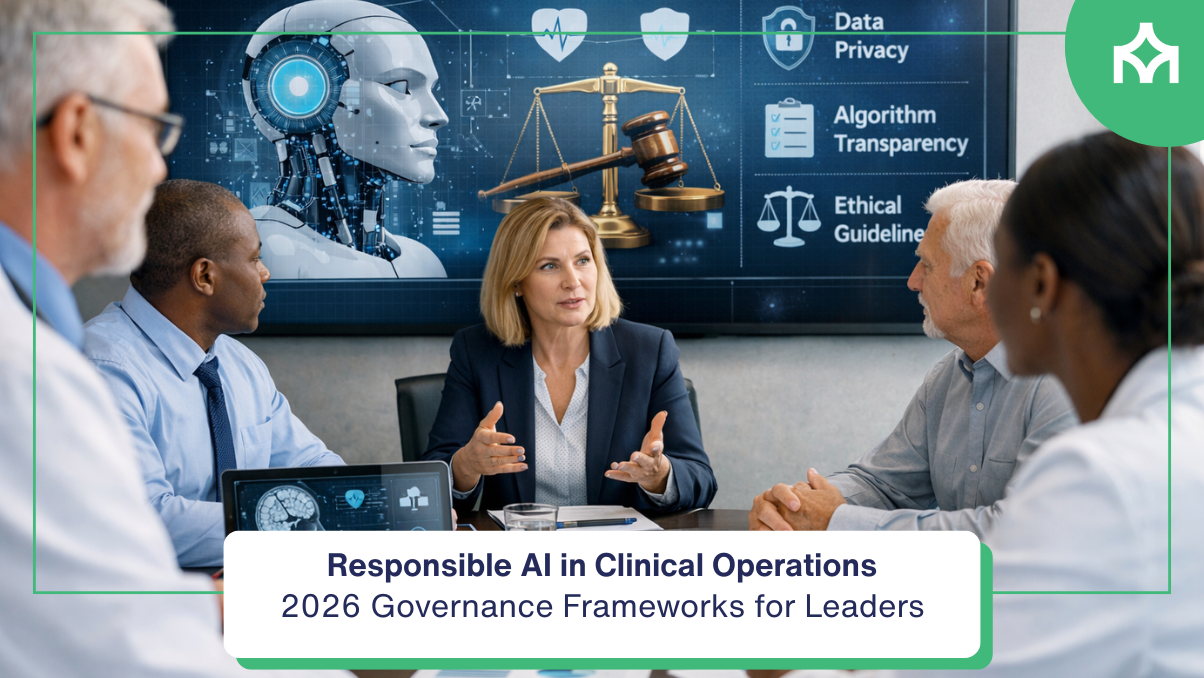
By 2026, Artificial Intelligence has transitioned from a localized pilot phase to the core operational fabric of the American health system. However, for the C-Suite, the integration of Large Language Models (LLMs) and predictive algorithms into clinical workflows and Revenue Cycle Management (RCM) introduces a new category of risk: Algorithmic Liability. Deploying AI without a robust governance framework is no longer just a technical oversight; it is a fiduciary failure. To protect the contribution margin and maintain clinical integrity, CFOs and COOs must move beyond "black box" implementations and adopt a Responsible AI (RAI) Governance Framework. The Hidden Risks of Unregulated AI Unchecked AI in clinical operations leads to three primary points of failure: Algorithmic Bias: Predictive models used in population health or prior authorization often unintentionally leverage proxies for socioeconomic status, leading to disparate care delivery and potential litigation (HHS Office for Civil Rights, 2025). Data Hallucinations in RCM: AI-driven autonomous coding that "guesses" modifiers or clinical indicators to bypass payer edits can trigger federal audits and False Claims Act (FCA) violations. The Transparency Gap: When a payer denies a high-acuity claim based on an automated "medical necessity" algorithm, the provider must be able to challenge that decision with an auditable, evidence-based counter-logic. The Solution: The 2026 Governance Framework A No-Regret AI strategy requires a three-pillar governance structure that ensures every automated decision is traceable, ethical, and financially sound.
1. Algorithmic Auditability and Transparency Leaders must mandate that every AI vendor provides "Explainable AI" (XAI). In clinical operations, this means the system must show the specific clinical documentation or payer rule it used to reach a conclusion. Action: Conduct quarterly algorithmic audits to verify that AI-driven charge capture and coding align with the latest AMA CPT code sets and CMS Final Rules (CMS, 2026). 2. Human-in-the-Loop Protocols AI should automate the mundane, but humans must authorize the critical. High-dollar clinical denials or complex surgical prior authorizations must have a mandatory human checkpoint. Action: Establish a "Clinical-Financial Oversight Committee" that reviews AI performance metrics, specifically focusing on the First-Pass Resolution Rate (FPRR) and the accuracy of AI-generated appeals. 3. Dynamic Data Integrity and Security Responsible AI is only as stable as its data foundation. Organizations must ensure that the data used to "train" or "fine-tune" their models is de-identified in compliance with HIPAA 2.0 standards and secured against adversarial machine learning attacks (NIST AI Risk Management Framework, 2025). Governance as a Competitive Advantage Adopting a Responsible AI framework is a method for Revenue Orchestration, not a cost centre. By 2026, patient trust will significantly increase and compliance-related denials will drop by 14% in health systems with transparent AI governance. The Financial Wins include: Lower Litigation Risk: Documented RAI frameworks provide a legal shield against claims of algorithmic bias. Payer Leverage: When your AI governance is superior to the payer's, you gain the upper hand in challenging automated denials. Operational Velocity: Clean, governed data allows for faster AI processing, reducing the time-to-payment for high-acuity procedures like robotic surgery or cardiology. Conclusion: Leading with Precision The mandate for 2026 is clear: Precision over speed. As leaders, your objective is to build an infrastructure where AI enhances human expertise without compromising ethical or financial standards. Governance is the bridge between AI as an experiment and AI as an enterprise asset.
Sources: (HHS Office for Civil Rights: Guidance on Algorithmic Bias, 2025) (CMS Final Rule: Interoperability and AI Transparency, 2026) (NIST AI Risk Management Framework 2.0, 2025) (Modality Global Advisors: RCM Trends Report, 2026) (AMA: Principles for AI in Health Care, 2024)