
RCM Maturity in UAE: Closing Gaps Between Policy and Practice
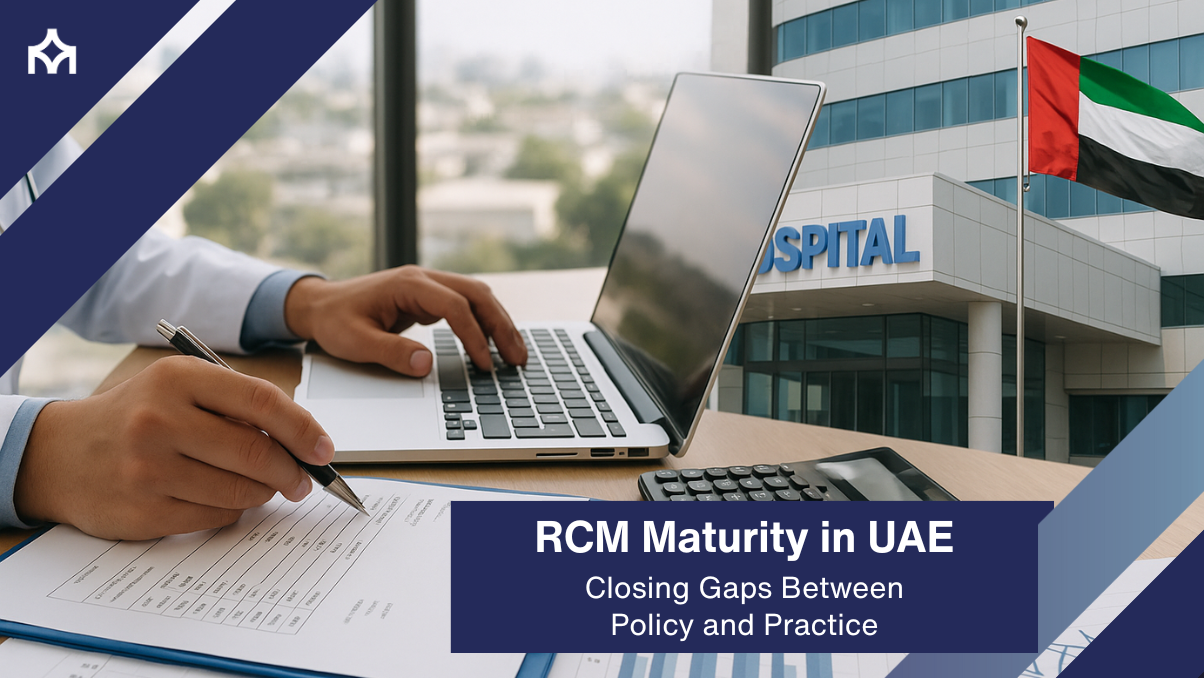
RCM Maturity in UAE: Closing Gaps Between Policy and Practice
The United Arab Emirates has established one of the region's most ambitious healthcare agendas, prioritizing high-quality services, patient rights, and advanced technology (UAE Government, 2025). Critical to realizing this vision is the Revenue Cycle Management (RCM) function, the financial engine of healthcare providers.
While the regulatory framework is increasingly sophisticated, with clear timelines for claim submission and remittance set by authorities like the Dubai Health Insurance Corporation (DHIC) and detailed adjudication rules from the Department of Health (DoH) Abu Dhabi a significant maturity gap often exists between policy and practice on the ground.
The Policy Landscape: A Foundation of Clarity
UAE regulators have actively worked to standardize the RCM environment:
- Standardized Timelines: Rules mandate clear deadlines for claim submission, resubmission, and payment, ensuring payers are held accountable for timely remittance (DHIC, 2023).
- Coding Compliance: The regular issuance of detailed coding modifiers and adjudication rules by local authorities (like DoH Abu Dhabi) is aimed at reducing errors and facilitating accurate billing (DoH, 2024).
- Digital Integration: Federal laws encourage the optimal use of Information and Communication Technology (ICT) in health fields to ensure data compatibility, security, and availability (UAE Federal Law No. 2 of 2019).
These measures provide a robust blueprint for an efficient, compliance-driven revenue cycle.
Challenges to RCM Maturity
Despite the clear regulatory roadmap, many healthcare providers struggle to reach a high RCM maturity level due to systemic and operational challenges:
- Fragmented Workflows: RCM often involves multiple, non-integrated systems from patient registration and clinical documentation to billing and accounts receivable (A/R). This fragmentation leads to manual intervention, higher error rates, and increased claim denial rates (Siddiqui & Alesaq-Madi, 2022).
- Lack of Automation: While the policy encourages technology, organizations at lower maturity stages often have limited automation of core processes like eligibility verification, claim status checks, and by-exception A/R workflows (ICD10monitor, 2024).
- Human Capital: RCM is complex, requiring specialized knowledge of constantly evolving payer and local authority rules. Insufficient staff training and high reliance on manual processes increase the risk of non-compliant billing and revenue leakage.
Three Pragmatic Steps To Close The Gap
- Operationalize data governance: A national strategy is only as good as local implementation. Health systems must standardize data definitions, enforce coding protocols, and ensure secure data exchange across EHRs, payers, and ancillary systems. Maturity models like HIMSS’s framework can help map progress and prioritize investments (HIMSS, 2024).
- Automate high-value workflows: Automation of eligibility verification, authorizations, claims-scrubbing, and denial routing reduces manual error and accelerates collections. Vendors and internal teams should prioritize interfaces that eliminate rework and enable near-real-time claim status tracking critical in an insurer-dense market.
- Apply analytics to revenue risk: Moving from descriptive reporting to predictive analytics allows teams to prioritize accounts and spot systemic denial drivers before they cascade. Predictive models can forecast denials, identify high-risk payers, and guide staffing to focus collections where impact is greatest (McKinsey, 2023).
A Call To Action
Policymakers and providers must align incentives: national digital strategies set the stage, but hospitals must operationalize those directives through governance, automation, and analytics.
For UAE providers, the next phase of health system modernization will depend on turning policy energy into predictable, measurable revenue outcomes so care, not receivables, remains the priority.
Closing the gap between the UAE’s world-class health policies and operational RCM practice demands a strategic partner capable of driving technological adoption, process re-engineering, and cultural transformation.
Sources
- DoH. (2024). Abu Dhabi DOH Medical Coding Modifiers.
- DHIC. (2023). RCM Rules (Standards Notice).
- ICD10monitor. (2024). The RCM Maturity Framework, Part Three: The Four Stages of Maturity.
- ResearchGate. (2024). Examining the Impact of AI and RPA Integration...
- Siddiqui, S., & Al-Madi, A. (2022). The Road Ahead and Challenges of Revenue Cycle Management in Saudi Governmental Hospitals.
- UAE Federal Law No. 2 of 2019. Concerning the Use of Information and Communication Technology (ICT) in Health Fields.
- UAE Government. (2025). Health strategies, policies and laws.
- HIMSS, 2024
- McKinsey, 2023